

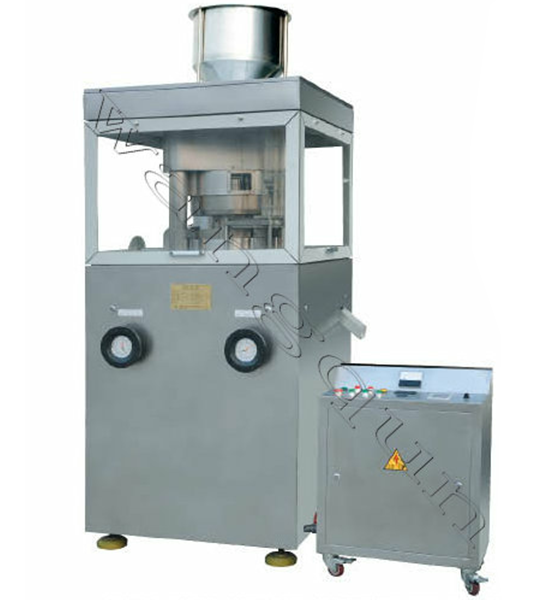
Tablet Press for Vitamin and Mineral Tablets: A Comprehensive Guide
Introduction
Tablet presses are essential machines in the pharmaceutical and nutraceutical industries, used to compress powdered ingredients into solid tablets. Vitamin and mineral supplements are among the most commonly produced tablets, requiring precise control over weight, hardness, and disintegration properties. This guide explores the working principles, types, components, and key considerations for selecting a tablet press for vitamin and mineral tablet production.
---
1. Working Principle of a Tablet Press
A tablet press operates by compressing powder or granulated material into tablets of uniform size, weight, and hardness. The process involves:
- Feeding: The powder blend is fed into the die cavity.
- Compression: Upper and lower punches apply pressure to form the tablet.
- Ejection: The finished tablet is ejected from the die.
The compression force must be carefully controlled to ensure tablet integrity without causing capping or sticking.
---
2. Types of Tablet Presses
2.1 Single-Punch Tablet Press (Eccentric Press)
- Principle: Uses a single set of punches and dies.
- Applications: Small-scale production, R&D, and clinical trials.
- Advantages: Simple operation, low cost, easy maintenance.
- Disadvantages: Low output (50-500 tablets per hour).
2.2 Rotary Tablet Press
- Principle: Multiple punches and dies rotate to produce tablets continuously.
- Applications: High-volume production of vitamins and minerals.
- Advantages: High speed (up to 1,000,000 tablets per hour), uniform compression.
- Disadvantages: Higher initial cost, complex maintenance.
2.3 Multi-Layer Tablet Press
- Principle: Compresses multiple layers of different powders into a single tablet.
- Applications: Multivitamin tablets with separate layers for different nutrients.
- Advantages: Enables controlled-release formulations.
- Disadvantages: More complex operation and tooling.
2.4 High-Speed Tablet Press
- Principle: Advanced rotary press optimized for ultra-high-speed production.
- Applications: Large-scale nutraceutical manufacturing.
- Advantages: Extremely high output, minimal downtime.
- Disadvantages: Requires high-quality raw materials to prevent defects.
---
3. Key Components of a Tablet Press
3.1 Hopper
- Stores and feeds the powder blend into the die system.
- Must ensure consistent flow to prevent variations in tablet weight.
3.2 Die and Punches
- Die: Cavity where powder is compressed.
- Punches: Upper and lower punches apply pressure to form the tablet.
- Materials: Typically made of high-grade steel for durability.
3.3 Turret
- Rotates to position dies and punches for compression (in rotary presses).
- Must be precisely machined to avoid misalignment.
3.4 Compression Rollers
- Apply force to the punches to compress the powder.
- Adjustable to control tablet hardness.
3.5 Ejection System
- Removes the finished tablet from the die.
- Must operate smoothly to prevent tablet damage.
3.6 Control Panel
- Modern tablet presses feature digital controls for:
- Compression force adjustment.
- Tablet weight monitoring.
- Speed regulation.
---
4. Factors Affecting Tablet Quality
4.1 Powder Characteristics
- Flowability: Poor flow can lead to inconsistent tablet weights.
- Particle Size: Affects compressibility and dissolution rate.
- Moisture Content: Excessive moisture can cause sticking.
4.2 Compression Force
- Too low: Weak tablets that crumble.
- Too high: Hard tablets that may not disintegrate properly.
4.3 Tooling Design
- Punch shape (flat, concave, beveled) affects tablet appearance and release properties.
- Proper maintenance prevents sticking and capping.
4.4 Lubrication
- Prevents sticking to punches and dies.
- Common lubricants: Magnesium stearate, stearic acid.
---
5. Tablet Formulation Considerations for Vitamins and Minerals
5.1 Excipients
- Binders: Improve tablet strength (e.g., microcrystalline cellulose).
- Disintegrants: Ensure rapid breakdown (e.g., croscarmellose sodium).
- Fillers: Add bulk (e.g., lactose, dicalcium phosphate).
- Lubricants: Prevent sticking (e.g., magnesium stearate).
5.2 Coating (Optional)
- Film Coating: Improves appearance, taste masking, and stability.
- Enteric Coating: Protects sensitive ingredients from stomach acid.
5.3 Stability Testing
- Vitamins (e.g., Vitamin C, B-complex) are sensitive to heat and moisture.
- Minerals (e.g., iron, calcium) may require chelation for better absorption.
---
6. Common Tablet Defects and Solutions
| Defect | Cause | Solution |
|------------------|-----------------------------------|-------------|
| Cracking | Excessive compression force | Reduce force, optimize formulation |
| Sticking | Poor lubrication, high moisture | Add lubricant, dry powder |
| Chipping | Weak tablet edges | Adjust punch design, increase binder |
| Weight Variation | Uneven powder flow | Improve hopper design, granulate powder |
---
7. Regulatory and Safety Considerations
- GMP Compliance: Tablet presses must meet Good Manufacturing Practice (GMP) standards.
- Cleaning and Validation: Regular cleaning prevents cross-contamination.
- Dust Control: Enclosed systems reduce exposure to fine powders.
---
8. Future Trends in Tablet Press Technology
- AI and Automation: Smart sensors for real-time quality control.
- 3D Printing: Customized tablet shapes and dosages.
- Continuous Manufacturing: Eliminates batch processing for higher efficiency.
---
Conclusion
Selecting the right tablet press for vitamin and mineral production requires careful consideration of speed, compression force, and formulation requirements. Rotary presses are ideal for high-volume production, while single-punch machines suit small-scale operations. Proper tooling, powder preparation, and quality control ensure consistent tablet performance. As technology advances, automation and smart manufacturing will further enhance efficiency and precision in tablet production.
Copyright © 2025 Changzhou Wangqun Pharmaceutical Machinery Co., Ltd. Tous droits réservés.
Plan du siteCe site Web utilise des cookies pour vous garantir la meilleure expérience sur notre site Web.
 English
 Español
 Pусский
 العربية



 Téléphone
Commentaire
(0)